
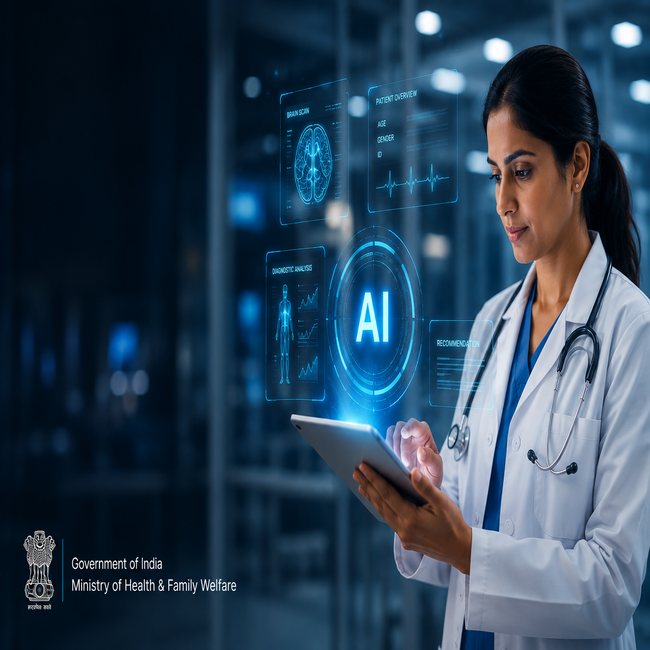

India has launched the AI Doctors Mission in New Delhi as part of broader efforts to strengthen digital healthcare infrastructure and expand the use of artificial intelligence within medical and public health systems.
According to reports, the initiative aims to improve healthcare accessibility, support medical professionals and accelerate technology-driven healthcare delivery through AI-powered systems and digital platforms. The launch reflects growing government interest in integrating emerging technologies into healthcare operations and patient services.
Industry observers say artificial intelligence is increasingly being explored across healthcare ecosystems for diagnosis support, patient monitoring, medical record management and healthcare accessibility, particularly in regions with limited medical infrastructure.
The broader healthcare technology sector has witnessed rapid expansion over the past two years as governments, hospitals and private healthcare providers increase investments in AI-driven systems, telemedicine platforms and digital health services.
Reports suggest the AI Doctors Mission is expected to focus on improving healthcare delivery efficiency and supporting medical professionals through intelligent digital tools capable of assisting in data analysis, patient assessment and healthcare coordination.
Industry analysts believe AI-assisted healthcare systems could help address shortages of medical professionals in underserved regions by enabling faster access to healthcare guidance and remote consultation support. Governments globally are exploring AI-based public health solutions as healthcare demand continues rising.
The launch also aligns with India’s wider push toward digital transformation and AI adoption across sectors including governance, education, agriculture and healthcare. Policymakers have increasingly highlighted artificial intelligence as a strategic growth area within the country’s digital economy plans.
Reports indicate healthcare remains one of the fastest-growing areas for AI deployment as hospitals and medical institutions seek ways to improve operational efficiency, reduce administrative burden and strengthen patient care systems.
Industry executives say AI-powered healthcare systems can assist doctors by analysing medical data, identifying patterns and improving diagnostic workflows. However, they also emphasise that human oversight remains essential within clinical decision-making processes.
The latest initiative reflects growing efforts to combine technology infrastructure with public healthcare access in a country where healthcare demand continues expanding across urban and rural populations. Digital healthcare services have become increasingly important following the rapid growth of telemedicine adoption in recent years.
Analysts believe AI-based healthcare support systems could improve early-stage disease detection, remote consultation access and healthcare information management if implemented effectively and responsibly.
At the same time, experts continue raising concerns around data privacy, algorithmic accuracy and ethical oversight within AI healthcare systems. Questions around patient consent, data security and medical accountability remain central to ongoing discussions surrounding healthcare AI deployment.
Reports suggest healthcare organisations are increasingly exploring AI tools capable of supporting multilingual healthcare communication and patient engagement, particularly within diverse linguistic environments such as India.
Industry observers note that public healthcare systems worldwide are under pressure to modernise digital infrastructure as populations grow and healthcare delivery becomes more data-intensive. AI is increasingly being positioned as a tool capable of supporting scalable healthcare services.
The launch of the AI Doctors Mission also comes as India continues strengthening domestic AI capabilities and digital public infrastructure across multiple sectors. Policymakers have highlighted the importance of balancing technological innovation with responsible implementation practices.
Healthcare technology companies globally are increasing investments in AI-assisted diagnostics, medical imaging, patient management and predictive healthcare analytics as demand rises for more efficient healthcare ecosystems.
Experts believe AI-driven healthcare systems are likely to play a larger role in future public health strategies as countries attempt to improve accessibility, operational efficiency and preventive healthcare outcomes.
The AI Doctors Mission underscores how artificial intelligence is becoming increasingly integrated into healthcare planning and service delivery strategies. Analysts say technology-driven healthcare initiatives could significantly influence how medical services are delivered, managed and accessed across India’s expanding digital healthcare ecosystem in the coming years.