
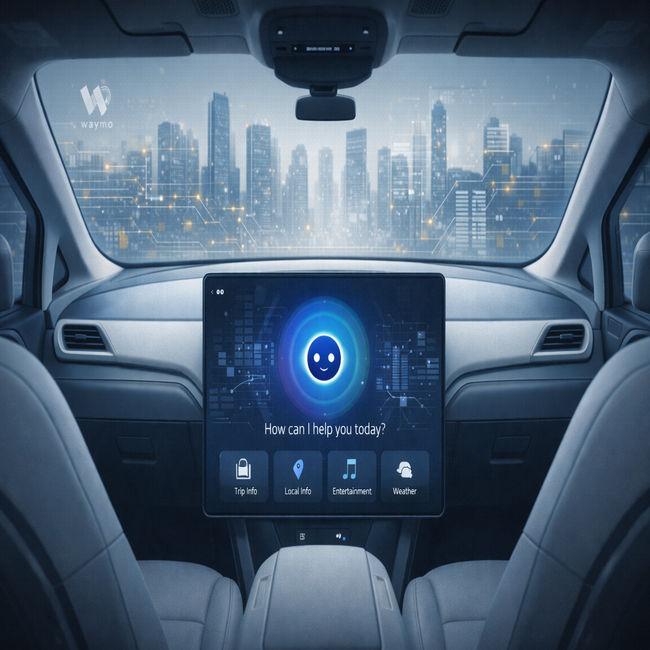

Waymo has begun testing Google’s Gemini artificial intelligence model as an in-car assistant within its autonomous robotaxi fleet, marking a significant step in the evolution of passenger interaction inside self-driving vehicles. The pilot reflects growing interest in integrating generative AI systems into autonomous mobility services to enhance user experience beyond navigation and safety.
The testing phase focuses on how Gemini can function as a conversational interface for passengers during rides. Unlike traditional voice assistants that handle predefined commands, Gemini is designed to engage in more natural, context-aware conversations. Waymo is exploring whether such capabilities can add value inside robotaxis, where there is no human driver to assist passengers.
Waymo operates one of the most advanced autonomous driving programmes globally, with robotaxi services running in select US cities. While the core autonomous driving system handles navigation, perception and safety, the passenger experience inside the vehicle has become an area of increasing focus as autonomous rides move closer to mainstream adoption.
By introducing an AI assistant powered by Gemini, Waymo is testing how generative AI can support passengers with ride-related queries, local information and general assistance. The assistant is not intended to control the vehicle or influence driving decisions. Instead, it functions as an informational and conversational layer, separate from the autonomous driving stack.
This distinction is critical, as safety systems in autonomous vehicles operate under strict validation and regulatory frameworks. Waymo has emphasised that Gemini’s role is limited to passenger interaction and does not interfere with vehicle operations. The AI assistant runs independently from the systems responsible for navigation and decision-making.
The use of Gemini aligns with broader developments within Google’s AI ecosystem. Gemini is positioned as a general-purpose AI model capable of handling complex language tasks, reasoning and contextual understanding. Integrating such a model into a robotaxi environment allows Waymo to test its performance in a real-world, time-bound setting where user expectations are high.
In a robotaxi context, passengers may have questions about the route, estimated arrival times or nearby points of interest. An AI assistant can help address these queries without requiring external apps or devices. It may also support accessibility by assisting passengers who need additional guidance during their ride.
The testing phase is expected to evaluate how well Gemini handles conversational accuracy, latency and relevance within a moving vehicle. Autonomous rides present unique challenges, including background noise, varying connectivity and the need for concise responses that do not distract passengers.
Waymo’s experiment reflects a wider trend in the mobility and automotive sectors, where AI assistants are increasingly seen as central to in-vehicle experiences. Traditional carmakers and technology companies are exploring how generative AI can personalise infotainment, provide real-time assistance and create more engaging journeys.
For robotaxi services, the role of an AI assistant is particularly significant. Without a driver, passengers may seek reassurance, explanations or help during unexpected situations such as rerouting or delays. A conversational AI interface could help bridge this gap by providing timely information and maintaining transparency.
At the same time, deploying generative AI in autonomous vehicles raises important questions around reliability, privacy and trust. Passenger interactions may involve sensitive data, including location and personal preferences. Ensuring that data is handled responsibly and securely is a key consideration for Waymo as it tests the technology.
The pilot also highlights how AI assistants are evolving beyond smartphones and smart speakers into embedded, context-rich environments. Vehicles offer a controlled setting where AI can combine conversational abilities with situational awareness, potentially enabling more relevant interactions.
Industry observers note that the success of such integrations will depend on execution rather than novelty. Passengers are unlikely to tolerate inaccurate or overly verbose responses, particularly in a confined environment like a vehicle. Balancing helpfulness with simplicity will be crucial.
Waymo has not indicated when or if Gemini-powered assistance will be rolled out more broadly across its fleet. The testing phase is intended to gather insights into user behaviour, system performance and operational considerations. Feedback from passengers is expected to play a role in shaping future iterations.
The move also underscores increasing convergence between autonomous driving and generative AI development. While autonomous vehicles rely heavily on specialised AI systems for perception and control, generative models are being layered on top to enhance interaction and engagement.
For Google, the testing represents another application of Gemini in a high-visibility, real-world environment. Demonstrating that the model can operate reliably in dynamic settings could support broader adoption across industries.
As robotaxi services expand, differentiation will increasingly come from passenger experience rather than core driving capability alone. Features that improve comfort, clarity and engagement may influence user preference and trust in autonomous mobility.
Waymo’s cautious approach to testing Gemini reflects awareness of the stakes involved. Introducing new AI capabilities in autonomous vehicles requires careful separation between safety-critical systems and experimental features. Maintaining this boundary is essential to preserving public confidence.
The experiment also raises broader questions about the future role of AI assistants in mobility. As vehicles become more autonomous, the cabin may transform into a digital space where passengers interact with services, content and information through conversational interfaces.
For now, Waymo’s testing of Gemini as an in-car assistant represents an exploratory step rather than a definitive product launch. It signals interest in understanding how generative AI can complement autonomous mobility without compromising safety or reliability.
As the pilot progresses, insights from this initiative may inform how AI assistants are designed for transportation use cases. The outcome could shape not only Waymo’s future offerings but also broader expectations around AI-driven experiences in autonomous vehicles.