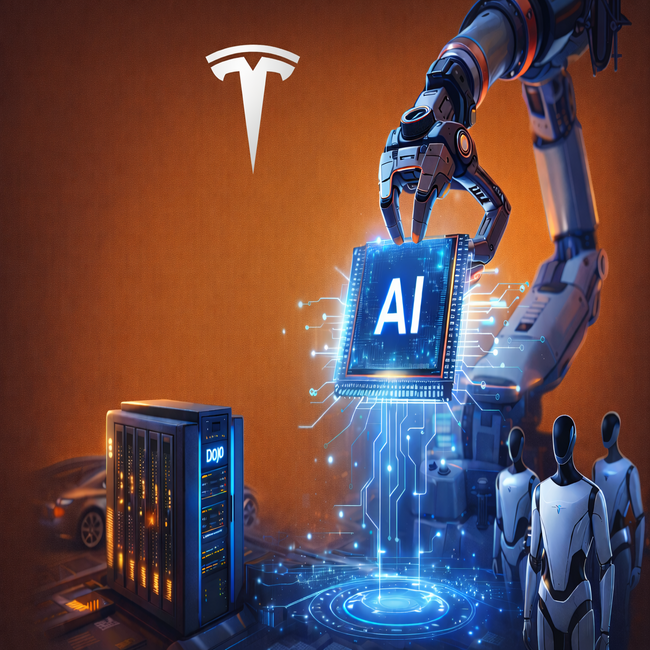

Tesla is preparing to launch a new manufacturing initiative called the Terafab project, aimed at scaling production of artificial intelligence chips used to power its growing AI infrastructure. The initiative reflects the company’s increasing focus on building in house computing capabilities to support autonomous driving, robotics and advanced machine learning systems.
The Terafab project is expected to focus on the large scale manufacturing of Tesla’s custom AI chips that are designed to run the company’s neural networks. These chips are used primarily in Tesla’s data centers and vehicles to process massive amounts of data generated by cameras and sensors.
Tesla has been investing heavily in artificial intelligence as part of its long term strategy to advance self driving technology and automation. The company’s vehicles rely on neural networks trained on large volumes of real world driving data collected from Tesla cars operating globally. Processing and training these networks requires significant computing infrastructure, which has led Tesla to develop its own specialised chips and AI hardware systems.
The proposed Terafab facility is expected to streamline the production of Tesla’s AI chips while improving efficiency and scale. The project could allow Tesla to reduce its reliance on external chip suppliers and gain greater control over its computing supply chain.
Industry observers note that the move reflects a broader trend among major technology companies to design and produce custom chips tailored for artificial intelligence workloads. Companies such as Google, Amazon and Microsoft have already developed their own AI accelerators for cloud infrastructure and machine learning applications.
Tesla began developing custom AI chips several years ago to support its Full Self Driving software and training infrastructure. These chips are used in Tesla’s Dojo supercomputer, a system designed specifically to train neural networks used in autonomous driving.
The Dojo system processes video data collected from Tesla vehicles to improve object recognition, road understanding and driving decisions. As Tesla continues to expand its fleet and collect more driving data, the demand for computing power to train these networks is increasing rapidly.
The Terafab project is expected to support this demand by creating a dedicated manufacturing system for Tesla’s AI processors. By increasing production capacity, the company could accelerate the development and deployment of its artificial intelligence systems.
Tesla’s interest in building its own chip manufacturing capabilities also reflects concerns about supply chain constraints that have affected the semiconductor industry in recent years. Shortages and geopolitical tensions have prompted many technology companies to seek greater independence in hardware production.
By investing in specialised manufacturing infrastructure, Tesla aims to ensure that its AI hardware roadmap remains aligned with its broader technological ambitions. The Terafab initiative could also support the company’s future projects in robotics and automation.
Tesla has been developing humanoid robots through its Optimus program, which relies on artificial intelligence systems similar to those used in its vehicles. These robots are expected to perform repetitive or dangerous tasks in industrial environments. The computing power required for such applications is likely to increase as Tesla expands its robotics research.
Another area where AI hardware plays a critical role is Tesla’s data center operations. Training large neural networks requires enormous computational resources, often involving thousands of processors working simultaneously. Custom chips designed specifically for these workloads can deliver higher efficiency compared with general purpose hardware.
The Terafab project could therefore become a key component of Tesla’s broader AI infrastructure strategy. By producing chips optimised for its own software and neural networks, Tesla may be able to improve performance while reducing operational costs.
Tesla’s approach also highlights the growing importance of vertical integration in the AI industry. Controlling both hardware and software allows companies to optimise systems more effectively and reduce dependence on external suppliers.
For Tesla, the combination of custom chips, dedicated supercomputers and large scale training datasets forms the foundation of its artificial intelligence roadmap. The company believes that improving neural network training and inference capabilities will be essential for achieving fully autonomous vehicles.
However, building advanced semiconductor manufacturing capabilities is a complex and capital intensive undertaking. Semiconductor fabrication requires specialised equipment, highly controlled environments and significant expertise. While Tesla has extensive experience in manufacturing vehicles and battery systems, expanding into chip production represents a new challenge.
Some analysts suggest that Tesla may collaborate with existing semiconductor manufacturers while focusing on design and system integration. This hybrid approach would allow the company to maintain control over chip architecture while leveraging established fabrication expertise.
The Terafab initiative underscores the intensifying competition among technology companies to build the most powerful AI infrastructure. As artificial intelligence becomes central to industries ranging from transportation to robotics, control over computing hardware is emerging as a strategic advantage.
Tesla’s investment in custom chips and manufacturing capabilities indicates that the company views artificial intelligence as a core pillar of its future growth. Whether through autonomous vehicles, robotics or large scale machine learning systems, the demand for specialised computing hardware is expected to increase significantly.
As the Terafab project progresses, it may signal a broader shift in how technology companies approach AI infrastructure. Instead of relying solely on external suppliers, more companies could pursue vertically integrated strategies that combine hardware design, software development and data infrastructure within a single ecosystem.