
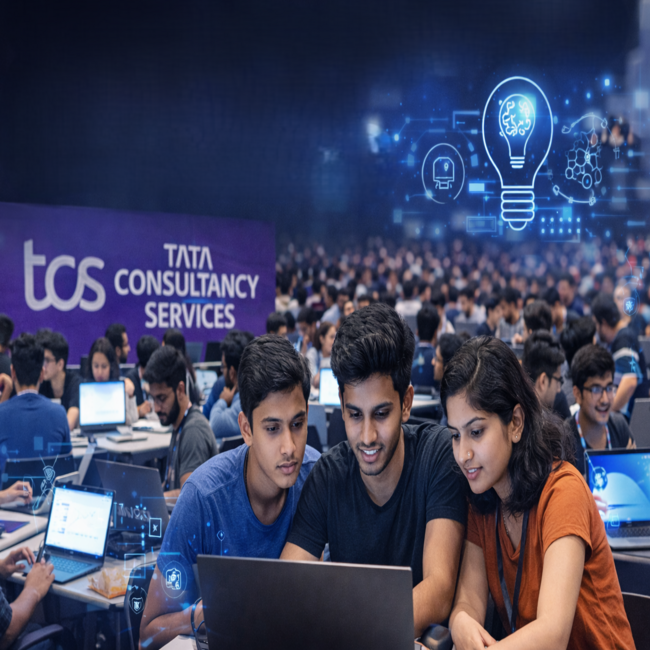

Tata Consultancy Services has organised a nationwide artificial intelligence hackathon involving more than 10,000 students, positioning the initiative as a key step toward building AI capabilities among India’s future technology workforce. The event was held ahead of the India AI Impact Summit and reflects growing industry focus on early talent engagement in emerging technologies.
The hackathon brought together students from engineering colleges and universities across the country, offering them an opportunity to apply AI concepts to real world problem statements. Participants were encouraged to develop solutions that address practical challenges across domains such as healthcare, sustainability, education, governance and enterprise productivity.
According to the company, the initiative was designed to bridge the gap between academic learning and industry requirements by exposing students to applied artificial intelligence use cases. Through the hackathon format, students worked in teams to conceptualise, design and prototype AI driven applications within a defined timeframe.
TCS stated that the scale of participation underscores rising interest among students in artificial intelligence and related fields. As AI adoption accelerates across industries, technology companies are increasingly seeking ways to nurture job ready skills early in the education lifecycle. The hackathon aimed to provide hands on exposure to AI tools, frameworks and problem solving methodologies.
The event also served as a platform for collaboration and mentorship. Industry experts and TCS professionals guided participants through technical challenges, offering insights into solution design, model development and ethical considerations in AI deployment. The mentorship component was positioned as a way to help students align their ideas with real world constraints and expectations.
The hackathon format encouraged innovation under time pressure, a skill increasingly valued in technology roles. Teams were assessed on criteria such as originality, feasibility, scalability and societal impact. Winning teams were recognised for their ability to translate abstract AI concepts into functional prototypes with practical relevance.
TCS indicated that the initiative aligns with its broader commitment to supporting India’s digital talent ecosystem. As the country positions itself as a global technology hub, developing a workforce proficient in advanced technologies such as AI, machine learning and data science is seen as critical. Industry led programs are increasingly complementing formal education pathways to accelerate skill development.
The timing of the hackathon ahead of the India AI Impact Summit highlights its strategic relevance. The summit is expected to bring together policymakers, industry leaders, researchers and educators to discuss the future of artificial intelligence in India. By engaging students in advance, TCS aims to ensure that emerging talent is part of the broader AI conversation.
Observers note that large scale hackathons have become an effective tool for technology companies to identify promising talent while fostering innovation at the grassroots level. Such initiatives allow organisations to gauge problem solving abilities, creativity and teamwork skills in real time settings. For students, they offer exposure to industry expectations and potential career pathways.
The focus on socially relevant problem statements also reflects a shift in how AI innovation is being framed. Rather than limiting AI applications to commercial optimisation, the hackathon encouraged solutions that could address public good challenges. This approach aligns with growing discourse around responsible and inclusive AI development.
TCS highlighted that ethical considerations were an integral part of the hackathon framework. Participants were encouraged to think about data privacy, bias and transparency while designing their solutions. As AI systems increasingly influence decision making, embedding ethical awareness at the student level is viewed as an important foundation.
The initiative also reflects changing recruitment and engagement strategies within the technology sector. With rapid advancements in AI, companies are placing greater emphasis on continuous learning and adaptability. Hackathons provide a dynamic environment to assess these attributes beyond traditional academic metrics.
While the hackathon concluded with awards and recognition, TCS indicated that the engagement would extend beyond the event. Selected participants may receive further opportunities for mentorship, internships or learning programs, although specific outcomes were not detailed at the time of announcement.
Industry analysts suggest that sustained engagement will be key to converting such initiatives into long term talent pipelines. As AI technologies evolve quickly, students will need ongoing access to updated tools and learning resources to remain relevant. Collaboration between academia and industry is expected to play a central role in this process.
The scale of participation also signals the growing appetite for AI education among India’s student population. With increased access to digital learning platforms and open source tools, students are actively seeking opportunities to apply theoretical knowledge in practical contexts. Hackathons provide a structured yet flexible environment for such experimentation.
As India continues to shape its national AI strategy, initiatives that focus on skill building and innovation at the student level are likely to gain prominence. The TCS hackathon illustrates how industry players are contributing to this ecosystem by creating platforms for learning, experimentation and collaboration.
By hosting a nationwide AI hackathon ahead of a major industry summit, TCS has positioned the initiative as both a talent development exercise and a statement of intent. It reflects the company’s view that the future of artificial intelligence depends not only on advanced research but also on cultivating a broad base of skilled and responsible practitioners.