
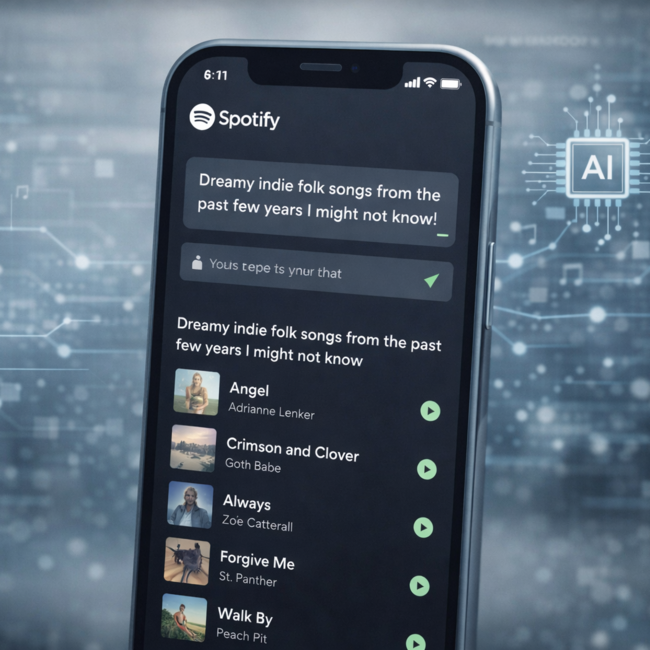

Spotify has begun testing a new artificial intelligence powered feature called Prompted Playlists, signalling an evolution in how the streaming platform approaches music discovery and personalisation. The feature allows users to create playlists by entering text prompts that describe what they want to listen to, rather than relying solely on algorithmic recommendations generated in the background.
Prompted Playlists is currently being rolled out as a limited beta for Premium subscribers in select markets. The feature invites listeners to describe their desired playlist using natural language, such as specifying a mood, an activity, a time period or a mix of familiar and new music. Spotify’s AI then combines this input with the user’s long term listening history to generate a customised playlist.
Unlike traditional recommendation tools that focus on recent listening behaviour, Prompted Playlists draws from a broader span of user data. The system is designed to consider years of listening patterns, favourite artists, genres and previously saved tracks. This approach aims to produce playlists that feel both personal and contextually relevant, while still introducing discovery elements.
Spotify has framed the feature as a way for users to actively guide the platform’s recommendation engine. Instead of passively receiving suggestions, listeners can shape their music experience by describing what they want to hear at a specific moment. The company believes this gives users greater agency over the algorithm and creates a more interactive relationship between listeners and the platform.
Users can refine their playlists over time by editing their prompts or creating new ones. If a playlist does not fully match expectations, listeners can adjust the description to shift the mood, tempo or focus. Spotify has also introduced suggested prompt examples to help users get started, particularly those who may be unfamiliar with using text based instructions to generate playlists.
The feature builds on Spotify’s long standing investment in personalisation. Over the years, the company has introduced tools such as Discover Weekly, Daily Mixes and AI DJ, all of which aim to surface relevant music based on listening habits. Prompted Playlists represents a shift from prediction to collaboration, where users and algorithms work together to curate content.
Spotify executives have described the feature as an extension of the company’s broader artificial intelligence strategy. By combining user intent with behavioural data, the platform seeks to deliver more nuanced recommendations that adapt to changing preferences and contexts. The company has said that AI will continue to play a central role in shaping how users interact with music and audio content.
The initial rollout of Prompted Playlists is limited in scope. At launch, the feature is available only to Premium subscribers and supports English language prompts. Spotify has not yet confirmed when the feature will expand to additional regions or languages, noting that feedback from the beta phase will help inform future development.
Industry observers note that the feature reflects a broader trend across digital platforms toward greater user involvement in algorithmic systems. As artificial intelligence becomes more prevalent, companies are experimenting with ways to make algorithms more transparent and responsive to direct input. Prompted Playlists aligns with this shift by allowing users to explicitly state their preferences rather than relying on inferred behaviour alone.
The competitive landscape in music streaming has also influenced Spotify’s approach. Rival platforms have introduced AI driven discovery tools and interactive features that allow users to shape content feeds. By introducing Prompted Playlists, Spotify aims to differentiate itself through deeper personalisation and more flexible discovery options.
For artists and the music industry, the feature could have implications for how music is surfaced and consumed. Prompt driven playlists may create new pathways for listeners to discover tracks outside their usual listening patterns, depending on how prompts are interpreted by the AI. Spotify has not yet detailed how Prompted Playlists may influence artist exposure or recommendation dynamics.
Spotify has emphasised that the feature is still in an experimental phase. The company plans to monitor how users engage with Prompted Playlists, including how often prompts are refined and how satisfied listeners are with the results. Ongoing adjustments are expected as Spotify fine tunes how the AI interprets prompts and balances familiarity with discovery.
As streaming platforms continue to evolve, tools like Prompted Playlists highlight how artificial intelligence is reshaping user experience design. Rather than replacing human choice, Spotify’s approach suggests a model where AI acts as a responsive assistant that helps users articulate and realise their listening preferences.
If the beta proves successful, Prompted Playlists could become a core part of Spotify’s product offering. The feature represents a step toward more conversational and interactive music discovery, where users play a more active role in shaping the soundtracks of their daily lives.