
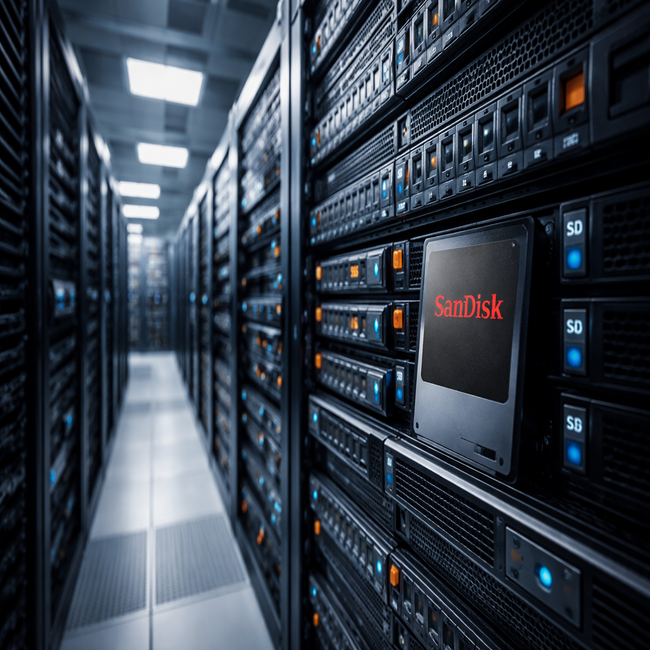

SanDisk Corporation reported a strong set of results for the second quarter of fiscal 2026 and raised its revenue outlook for the upcoming quarter, supported by rising demand for data storage linked to artificial intelligence workloads. The better-than-expected performance prompted a sharp rise in the company’s share price, reflecting growing investor confidence in storage providers positioned to benefit from AI-led infrastructure expansion.
For the quarter ended January 2, SanDisk posted revenue of approximately $3.03 billion, marking a year-on-year increase of over 60 percent and a sequential rise of more than 30 percent. The company also reported non-GAAP earnings per share of $6.20, significantly higher than market expectations. Gross margins expanded to above 51 percent, underscoring improved pricing and a favourable product mix.
Following the earnings announcement, SanDisk’s shares rose by around 20 percent in early trading, making it one of the strongest performers among technology stocks during the session. The market reaction reflected optimism around the company’s exposure to AI-driven data center demand, which has emerged as a major growth driver across the semiconductor and storage industries.
Company leadership attributed the strong quarter to rising adoption of its enterprise storage solutions by hyperscale data centers and cloud service providers. These customers increasingly require high-performance solid-state drives to support data-intensive AI workloads, including model training, inference, and real-time analytics. SanDisk said its NAND flash memory products are well positioned to meet these requirements.
Revenue growth was broad-based across segments. Data center revenue rose sharply on a quarter-on-quarter basis, driven by increased shipments of enterprise SSDs. The company also recorded growth in edge computing applications, while consumer storage revenue improved as demand stabilised following a prolonged downturn in the consumer electronics market.
SanDisk reported adjusted free cash flow of approximately $843 million during the quarter, reflecting strong operating performance and disciplined capital management. The company ended the period with a solid cash position, providing flexibility to support ongoing investments in manufacturing capacity, product development, and long-term supply agreements.
Looking ahead, SanDisk issued an upbeat forecast for the third quarter of fiscal 2026. The company expects revenue in the range of $4.4 billion to $4.8 billion, well above previous market estimates. It also guided for non-GAAP earnings per share between $12 and $14, alongside gross margins projected to remain in the mid-60 percent range.
Management said the outlook reflects continued momentum from AI-related infrastructure spending, as well as tight supply conditions in the NAND flash memory market. Demand from data centers deploying AI models is expected to remain elevated, while supply additions across the industry are being introduced cautiously following prior periods of oversupply.
Industry analysts noted that the combination of rising demand and controlled supply has improved pricing dynamics for storage manufacturers. This has enabled companies like SanDisk to expand margins while securing longer-term contracts with enterprise customers. The company also highlighted progress in qualifying next-generation high-performance drives with major hyperscale clients.
SanDisk continues to operate its manufacturing joint venture with Kioxia, which remains central to its production strategy. The partnership was recently extended through 2034, providing long-term visibility on capacity planning and technology development. The company said the agreement supports its ability to meet growing demand for advanced storage solutions.
Since becoming an independent company following its separation from Western Digital, SanDisk has sharpened its focus on flash memory and storage products. Investors have increasingly viewed the company as a direct beneficiary of AI-driven infrastructure investment, contributing to renewed interest in its stock.
Despite the strong outlook, some analysts cautioned that the memory and storage sector has historically been cyclical. Demand patterns can shift based on macroeconomic conditions, enterprise spending cycles, and the pace at which new manufacturing capacity comes online. These factors could influence pricing and margins over time.
SanDisk acknowledged these risks while maintaining that structural demand from AI and cloud computing represents a long-term opportunity. The company said it remains focused on aligning supply with demand, advancing its product roadmap, and strengthening relationships with key customers.
While the outlook remains positive, analysts continue to flag the cyclical nature of the memory and storage market, where demand can fluctuate based on supply additions and broader technology spending trends. For now, SanDisk’s latest results underline how AI-driven infrastructure investments are reshaping demand patterns in the storage industry, positioning the company as a key beneficiary of the ongoing shift toward data-intensive computing.
Related Articles


