
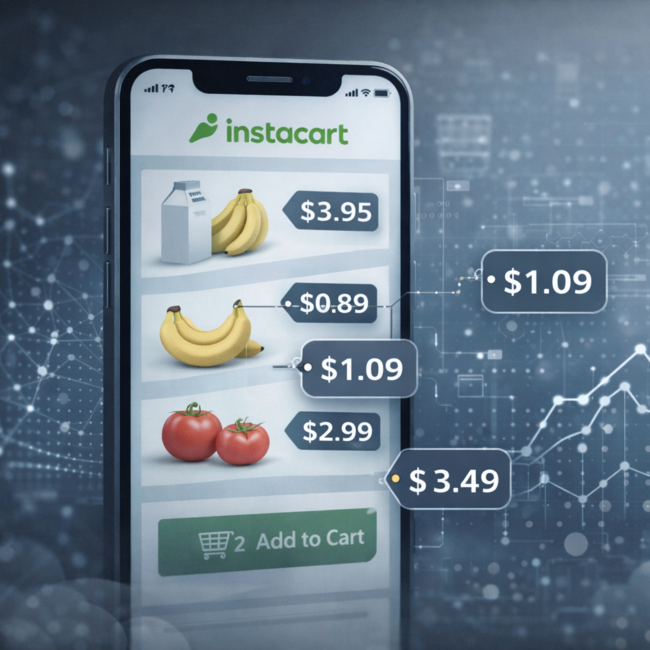

Instacart, a major grocery delivery and retail technology platform, is facing scrutiny from US regulators over its artificial intelligence driven pricing technology. The Federal Trade Commission has begun seeking information about the company’s AI based pricing tool following reports that shoppers may have been charged different prices for the same grocery items under similar conditions.
At the centre of the inquiry is Instacart’s pricing platform, Eversight, which the company uses to help retailers test price variations. The tool applies machine learning techniques to experiment with pricing strategies in real time. Regulators are examining how the system functions and whether its use aligns with consumer protection standards, particularly for essential goods such as groceries.
The inquiry follows the release of research indicating that customers shopping on the platform could see different prices for identical products at the same store and time. In some cases, the reported differences were significant. These findings have intensified debate around dynamic and algorithmic pricing, especially when artificial intelligence is used to influence prices for everyday necessities.
Instacart has said that its pricing experiments were randomised and not personalised. According to the company, the tests were designed to measure general consumer response rather than adjust prices based on individual customer data. Instacart has maintained that it does not use personal information such as demographics or shopping history to set prices and has compared the practice to traditional A B testing methods commonly used in digital commerce.
Despite these assurances, consumer advocates have raised concerns about transparency. Because pricing decisions are made by automated systems, shoppers may not be aware that they are participating in pricing experiments. Critics argue that this lack of visibility can undermine trust, particularly when price differences affect essential household purchases during periods of economic pressure.
The Federal Trade Commission’s inquiry reflects a broader regulatory focus on how artificial intelligence is deployed in commercial decision making. The agency has been increasingly attentive to algorithmic systems that influence prices, recommendations and access to services. Regulators are seeking to understand whether such systems could result in unfair or deceptive practices, even if companies do not intentionally target specific consumers.
Financial markets have reacted cautiously to news of the inquiry. Instacart’s parent company experienced a decline in its share price following reports of regulatory scrutiny, highlighting investor sensitivity to potential enforcement actions that could affect business models reliant on AI driven optimisation.
Instacart has expanded its use of artificial intelligence in recent years as part of a broader strategy to position itself as a retail technology provider rather than solely a delivery service. The company has invested in tools that support pricing optimisation, demand forecasting and in store automation. While these technologies are intended to help retailers improve efficiency and margins, they also expose companies to increased regulatory and public scrutiny.
The investigation also comes amid growing legislative interest in algorithmic pricing practices across the United States. Lawmakers in several states have raised questions about whether automated pricing systems should be subject to clearer disclosure requirements. Some proposals have suggested that consumers should be informed when prices are determined or influenced by algorithms, particularly for goods considered essential.
Research organisations and policy groups have pointed to pricing variability across digital platforms as evidence of the need for clearer rules. Studies comparing prices shown to different users have repeatedly found discrepancies, even when conditions appear similar. While such variation can be explained by experimentation or inventory management, critics argue that consumers deserve greater clarity around how prices are set.
Technology policy experts note that algorithmic pricing is not inherently problematic. Dynamic pricing has long been used in sectors such as travel and hospitality to manage supply and demand. However, the use of artificial intelligence increases the scale and speed of these practices, making oversight more complex. Without appropriate safeguards, automated systems can produce outcomes that are difficult for both consumers and regulators to interpret.
The outcome of the Federal Trade Commission’s inquiry could have implications beyond Instacart. As more companies adopt AI driven pricing and optimisation tools, regulatory guidance in this case may influence how similar technologies are deployed across retail, e commerce and service industries. Companies may face pressure to improve transparency, document decision making processes and demonstrate that their systems do not disadvantage consumers unfairly.
Instacart has indicated that it is cooperating with regulators and engaging in discussions about its technology. The company is expected to provide detailed information on how its pricing systems operate and how it ensures compliance with consumer protection laws. The investigation remains ongoing, and no conclusions have been announced at this stage.
As artificial intelligence becomes more deeply embedded in everyday commerce, questions around fairness, accountability and trust are likely to intensify. The scrutiny of Instacart’s pricing tool underscores the challenges facing companies that rely on complex algorithms to make decisions that directly affect consumers. How regulators respond may shape the future use of AI driven pricing across the digital economy.