
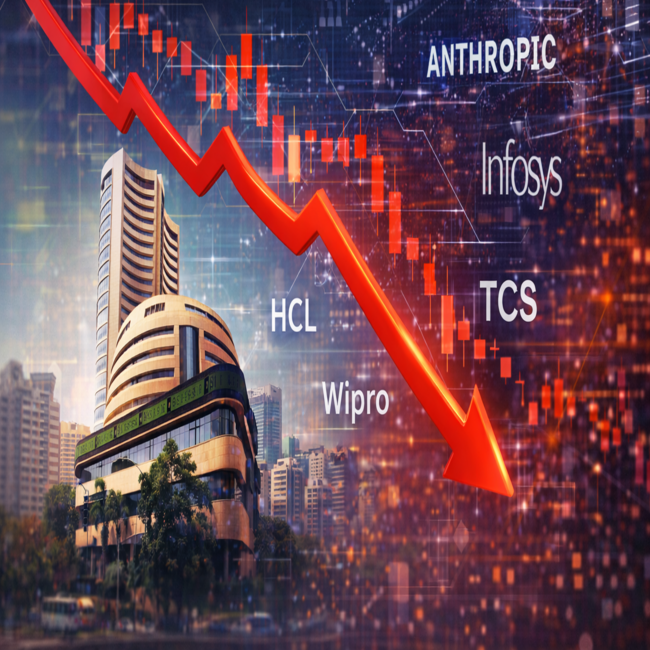

Indian technology and information technology stocks witnessed a decline after artificial intelligence company Anthropic introduced a new tool designed to assess and disclose potential risks associated with advanced AI systems. The development triggered investor concerns around regulatory scrutiny, compliance costs and the long-term impact on companies heavily invested in AI-driven services.
The tool, positioned as a framework to evaluate and communicate AI-related risks, is aimed at improving transparency around how powerful AI models behave in real-world environments. While the initiative aligns with growing global emphasis on responsible AI, market participants reacted cautiously, particularly in regions with large technology services sectors such as India.
Shares of several Indian IT and technology firms fell following the announcement, reflecting concerns that heightened AI oversight could increase operational complexity and costs. Indian IT companies generate a significant portion of revenue from global clients, many of whom are rapidly adopting AI to improve efficiency and competitiveness. Any change in how AI systems are governed has implications for service delivery and margins.
Anthropic’s tool is intended to help organisations identify potential risks in deploying advanced AI models, including unintended behaviour, misuse and safety concerns. By encouraging more detailed risk reporting, the framework adds another layer to how companies must manage and communicate AI deployments.
Investors appeared to interpret the move as a signal that AI regulation and accountability are entering a more formal phase. For Indian IT firms that provide AI development, integration and consulting services, this could translate into additional compliance requirements and longer deployment cycles.
The Indian IT sector has been positioning itself as a key partner for global enterprises adopting AI. Companies have invested heavily in building AI capabilities, training talent and developing proprietary tools. The sudden focus on risk disclosure raised questions about whether these investments could face near-term headwinds.
Market analysts noted that while responsible AI practices are necessary, the transition period can create uncertainty. Firms may need to revisit contracts, update governance frameworks and invest in additional safeguards, potentially affecting profitability in the short term.
The reaction also reflects broader nervousness in global markets around AI regulation. Governments and industry bodies are increasingly calling for guardrails around advanced AI systems. While such measures are intended to build trust, they can also slow adoption and increase costs.
Indian technology stocks have historically been sensitive to regulatory developments in key overseas markets. With clients in North America and Europe driving much of the demand for AI services, any shift in expectations around AI safety and disclosure has direct implications.
Some industry observers argued that the market reaction may be overstated. They pointed out that Indian IT firms have experience adapting to regulatory changes and often turn compliance into a value proposition for clients. Over time, stronger governance frameworks could enhance trust in AI solutions.
Others cautioned that the competitive landscape may shift. Companies with mature AI governance and risk management capabilities may gain an advantage, while those slower to adapt could face pressure.
The focus on AI risk assessment also raises questions about responsibility across the AI value chain. Technology providers, developers and users may all be expected to share accountability, complicating contractual relationships and project timelines.
Anthropic’s move comes amid increasing debate around how to balance innovation with safety. As AI systems become more capable, concerns about unintended consequences have grown. Transparency tools are seen as one way to address these concerns, but their implementation can be complex.
For Indian IT companies, the challenge will be integrating risk assessment into existing delivery models without undermining agility. Clients often demand rapid deployment and continuous improvement, which can conflict with extensive review processes.
The decline in stock prices highlights how closely financial markets are watching developments in AI governance. Even announcements from private AI companies can have ripple effects across global markets, underscoring AI’s systemic importance.
Despite the immediate market reaction, long-term demand for AI services remains strong. Enterprises continue to invest in automation, analytics and intelligent systems to drive growth and efficiency. Indian IT firms are central to these efforts due to their scale and expertise.
Analysts suggested that clearer regulatory frameworks could ultimately benefit the sector by reducing uncertainty. Once standards are established, companies can plan investments and offerings more confidently.
The episode also illustrates the interconnected nature of the global technology ecosystem. Decisions made by AI developers in one market can influence investor sentiment and business strategies elsewhere.
Indian policymakers have emphasised the importance of responsible AI development. Domestic firms may find opportunities in helping global clients navigate new AI governance requirements, turning compliance into a service offering.
In the near term, however, market volatility may persist as investors digest the implications of increased AI scrutiny. Technology stocks are likely to remain sensitive to signals around regulation, safety and transparency.
The response to Anthropic’s tool underscores a broader shift in how AI is perceived. Once viewed primarily as a growth driver, AI is now also seen as a source of risk that requires structured management.
As the AI landscape evolves, companies that can balance innovation with accountability may be better positioned to sustain growth. For Indian IT firms, adapting to these expectations will be critical.
While the immediate impact was a decline in stock prices, the longer-term outcome may depend on how effectively companies integrate risk assessment into their AI strategies.
Anthropic’s initiative has brought AI governance into sharper focus for markets. The reaction in Indian stocks reflects both caution and the recognition that AI’s next phase will be shaped as much by regulation as by technological breakthroughs.