
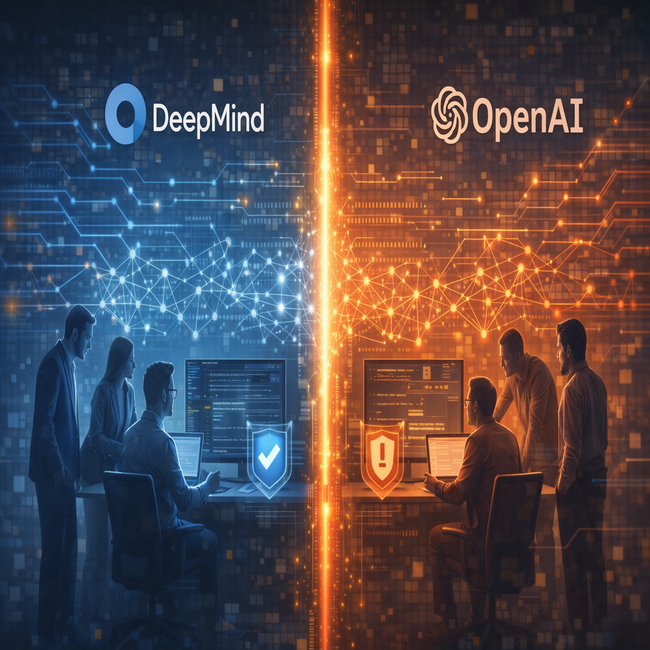

Google’s rapid advances in artificial intelligence development and leadership restructuring played a pivotal role in intensifying competition in the generative AI sector, triggering a code red moment inside OpenAI. The shift reflects how leadership decisions at major technology firms are increasingly shaping the pace and direction of AI innovation.
The development centres on Google’s AI strategy under the leadership of Demis Hassabis, the chief executive of Google DeepMind, whose role became more prominent following the consolidation of Google Brain and DeepMind into a single unit. The move was aimed at accelerating Google’s response to rapid advancements in generative AI and strengthening its competitive position against rivals such as OpenAI.
As Google reorganised its AI efforts and increased the pace of internal deployment, the competitive pressure across the industry intensified. OpenAI, which had gained early momentum through the public release of ChatGPT, began to face a more aggressive challenge from Google’s AI teams. This environment reportedly led OpenAI leadership to issue a code red internally, signalling heightened urgency and focus across teams.
The consolidation of Google’s AI divisions under Hassabis was designed to reduce fragmentation and improve execution speed. By bringing research, product development and deployment under a unified leadership structure, Google aimed to move more quickly from experimentation to real-world applications. This approach reflected growing recognition that AI leadership required not just research excellence but also operational discipline.
Hassabis, known for his background in neuroscience and game theory, has long positioned DeepMind as a research-first organisation. However, the competitive landscape forced a shift toward faster productisation. Google’s leadership increasingly emphasised the need to translate breakthroughs into deployable tools that could compete directly with OpenAI’s offerings.
The impact of this shift was felt across the industry. OpenAI’s internal code red was reportedly issued as Google accelerated development and integration of generative AI into its products. The alert underscored concerns that Google’s scale, resources and distribution could erode OpenAI’s early advantage if it did not move quickly.
At the heart of the competition is control over foundational AI models and their deployment across consumer and enterprise products. Google’s ability to integrate AI across search, productivity tools and cloud services represents a significant competitive lever. OpenAI, while influential, relies heavily on partnerships to reach users at similar scale.
The episode highlights how leadership decisions influence not only internal strategy but also market dynamics. Google’s move to empower a single AI leader sent a signal that the company was prepared to compete aggressively. For OpenAI, this meant recalibrating priorities and accelerating development timelines.
The code red moment inside OpenAI reflects broader pressures facing AI labs as competition intensifies. What was once a research-driven space has become a fast-moving commercial battleground. Companies are now racing to release models, secure partnerships and establish standards for AI deployment.
Industry observers note that the shift has implications beyond product launches. It influences hiring, investment and governance across the AI ecosystem. Leadership teams are under pressure to balance speed with safety, particularly as models become more powerful and widely used.
Google’s restructuring also underscores how large technology companies are adapting to the generative AI era. Traditional development cycles are being compressed, and organisational silos are being dismantled in favour of integrated AI teams. The goal is to reduce friction between research and deployment.
For OpenAI, the competitive pressure has reinforced the need for agility. The code red signalled a recognition that early success does not guarantee long-term leadership. Continuous innovation and rapid execution are now essential to maintaining relevance.
The episode also illustrates how AI competition is increasingly shaped by individuals as much as institutions. Leaders like Hassabis influence strategic direction through decisions on structure, prioritisation and risk tolerance. These choices ripple across the industry, affecting how competitors respond.
From a broader perspective, the intensifying rivalry reflects the maturation of generative AI. What began as experimental research has evolved into a core strategic asset for technology companies. Control over AI capabilities is now seen as critical to future growth and influence.
The pressure has also accelerated discussions around responsible AI development. As companies move faster, concerns around safety, bias and governance remain central. Leaders must ensure that speed does not compromise trust or regulatory compliance.
The competitive dynamic between Google and OpenAI highlights how the AI race is no longer linear. Advances by one player prompt rapid responses from others, creating cycles of acceleration. This environment rewards organisations that can align leadership, technology and execution.
For the wider technology and marketing ecosystem, these shifts have downstream effects. Faster AI deployment influences how tools are built, marketed and adopted across industries. Marketers, developers and enterprises are increasingly affected by decisions made at the top levels of AI organisations.
The code red moment inside OpenAI serves as a reminder that AI leadership is fluid. Dominance can shift quickly as strategies evolve and new capabilities emerge. Companies that fail to adapt risk losing ground in a highly competitive landscape.
Google’s leadership consolidation under Hassabis represents a calculated move to stay ahead in this environment. By streamlining decision-making and accelerating deployment, the company has signalled its intent to compete aggressively across AI domains.
As the generative AI race continues, leadership decisions will remain a critical factor. The episode underscores how strategic moves inside one organisation can reshape priorities across the entire industry, reinforcing the interconnected nature of AI competition.