
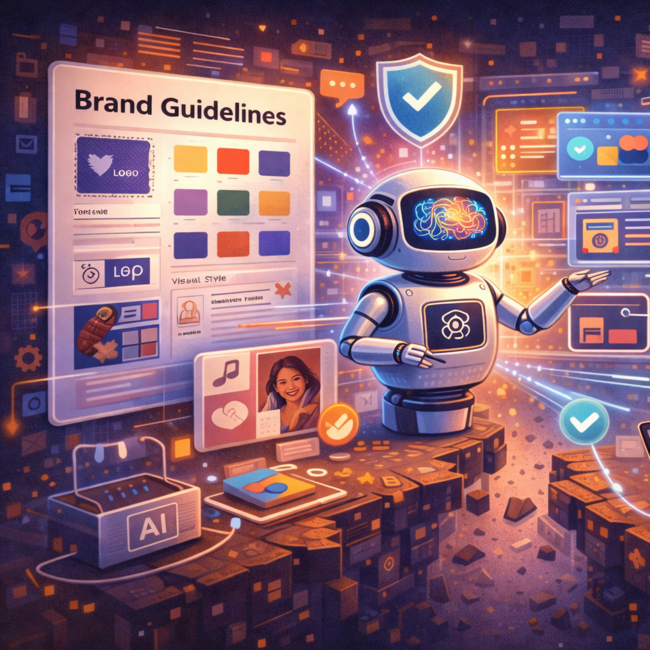

For many years, brand guidelines lived inside PDFs and printed manuals that teams downloaded, bookmarked, or saved on shared drives. They contained the rules of identity: approved logos, correct colors, typography, photography style and the tone a brand should use. These documents were static and relied on humans to interpret and enforce them. For a time, they were enough. Marketing moved at a measured pace, content travelled through long approval chains and most brand assets were created by a handful of designers.
The landscape is very different today. Brands create content every day for performance ads, social media, ecommerce listings, newsletters, chatbots and internal communications. Much of this work is supported or fully generated by artificial intelligence. With such volume and speed, the old PDF format is no longer sufficient. As one Indian CMO observed at an industry event, “We used to check for brand consistency at the end. Now there is no end. The work is continuous.”
This pressure has given rise to a new model where brand guidelines are not just documents but live systems powered by artificial intelligence. These AI guardrails accompany marketers inside their tools, quietly monitoring colors, layouts, typefaces, messaging and even tone. Instead of expecting a designer to remember eighteen pages of logo sizing rules, the AI surfaces the correct logo or warns when something is off-brand. In effect, the brand book has become active rather than passive.
The shift is happening because content demands have accelerated. Surveys from 2024 show that nearly 80 percent of Indian businesses now use AI in at least one marketing function. Brand governance becomes harder as more people generate assets and as generative AI tools accelerate output. At the same time, global research points out that inconsistent branding can reduce customer recognition and trust by up to 20 percent. The business risk of off-brand content grows with every platform a brand joins.
Indian marketing leaders have been candid about this inflection point. Ashwin Moorthy, Chief Marketing Officer at Godrej Consumer Products, has stated in industry discussions that artificial intelligence will disrupt the entire value chain, from insights to execution. His point is not about automation replacing people but about marketing becoming deeply interlinked with technology. In that context, brand governance cannot remain frozen in a PDF. It has to be part of the workflow.
This is already visible in the tools marketers use. Design platforms now include brand hubs that store approved logos, fonts, templates and brand colors. These elements appear automatically during creation. Generative AI tools can also be trained on brand-specific styles, allowing them to output images, layouts or copy that reflect the brand’s identity without manual intervention. India’s creative industry has been quick to adopt these systems. According to a 2024 marketing study, 66 percent of Indian brands were already using generative AI, and another 26 percent were piloting it. This adoption rate puts India ahead of several developed markets and reflects the scale at which Indian businesses operate.
Several Indian brands offer examples of how AI guardrails improve governance. Creative agencies working with large advertisers report cutting design revision cycles significantly after adopting AI-powered asset systems. One Indian agency that integrated AI-driven image generation into its workflow said campaign versioning became nearly three times faster while maintaining brand quality. These improvements are not limited to large enterprises. Indian startups, particularly ecommerce companies, are turning to AI tools to automate product listing images. Some of these platforms report reducing manual creative effort by over 80 percent and improving click-through rates by testing multiple variations of product visuals. The AI ensures that approved colors, layouts and tone remain consistent regardless of how many variations are produced.
The operational benefits are becoming clearer. Consistent branding has always shown a strong link to performance. Multiple studies indicate that strong brand consistency can lift revenue growth by 10 to 20 percent over time. AI guardrails strengthen this path by reducing human error and ensuring that every asset aligns with the brand. A global creative automation study in 2024 found that teams using AI-assisted brand governance tools scaled content output by up to 70 percent while reducing manual review time by as much as 75 percent. These are the kinds of gains Indian brands now seek as they operate at real-time speed.
The growing role of AI in brand governance has also influenced marketing team structures. Creative teams, who once spent hours verifying that every color and typeface matched the rulebook, now rely on systems to check compliance automatically. This frees them to focus on strategy and storytelling rather than mechanical quality control. Gunjan Khetan, Chief Marketing Officer at Perfetti Van Melle, has said that marketers must now combine creative instincts with data and technology fluency. Her point reflects a broader reality: modern brand management requires both imagination and the ability to work alongside intelligent systems.
There is also a shift in leadership mindset. Abhishek Chakraborty, head of brand communication at Oriflame, has spoken about how AI changes a brand manager’s role. Instead of micromanaging, he says, the job is to set clear guardrails and let the system enforce them. Leaders become stewards rather than supervisors. This mirrors the experience of many Indian marketing teams who find that AI governance reduces repetitive tasks while maintaining control.
The agency ecosystem is also adapting. In the past, brand guidelines were handed off during onboarding. Today, agencies increasingly work within a client’s AI-powered brand system. This reduces misalignment and speeds approvals because the constraints are visible from the first draft. It also demands new skills from agency teams, who must learn to operate with brand rules that are automated and sometimes strict.
Data suggests this transition will expand rapidly. India’s martech market is projected to reach nearly 94 billion dollars by 2030, driven by investments in automation, creative tooling and brand governance platforms. Global marketing technology spending is expected to cross 148 billion dollars in 2024. Much of this investment is being pushed into systems that help brands maintain control in high-speed, high-volume environments.
Automation, however, does not erase the need for human oversight. Santosh Singh, marketing leader at Tata Technologies, has publicly emphasized that generative AI should be treated as an upskilling tool. His message reflects a sentiment widely shared among industry leaders: AI can automate enforcement, but only humans can protect brand meaning, emotion and long-term strategy. The best outcomes emerge when teams pair human judgment with AI rigor.
There are also ethical and regulatory considerations. In India, financial services, healthcare and insurance brands must comply with strict communication standards. AI guardrails help ensure mandatory disclaimers and language remain intact. At the same time, consumers expect transparency. Recent surveys show that almost all Indian consumers believe brands should disclose when AI has been used in communications. This expectation is shaping how companies build their governance frameworks.
As AI becomes more deeply integrated into creation, many expect the next evolution of brand guidelines to be fully interactive. Rather than reading a document, a marketer might ask an AI assistant how to maintain tone in a regional language, or how a visual should be adapted for a new format. The assistant would pull from the brand’s rules and past campaigns, offering compliant suggestions instantly.
The future of brand governance will likely be hybrid: human creativity guided by intelligent systems. The brand book will not disappear, but it will no longer sit quietly in a folder. It will live inside the tools, checking, nudging and guiding every asset that moves through the ecosystem.
For brands facing the speed of today’s marketing landscape, this evolution is not optional. It is already underway. As Chakraborty put it, “It is not an option. AI is transforming the way we work.” Brands that convert their guidelines into guardrails will be the ones that maintain consistency, trust and identity at scale, even as marketing accelerates faster than ever.
Disclaimer: All data points and statistics are attributed to published research studies and verified market research. All quotes are either sourced directly or attributed to public statements.
Related Articles


