
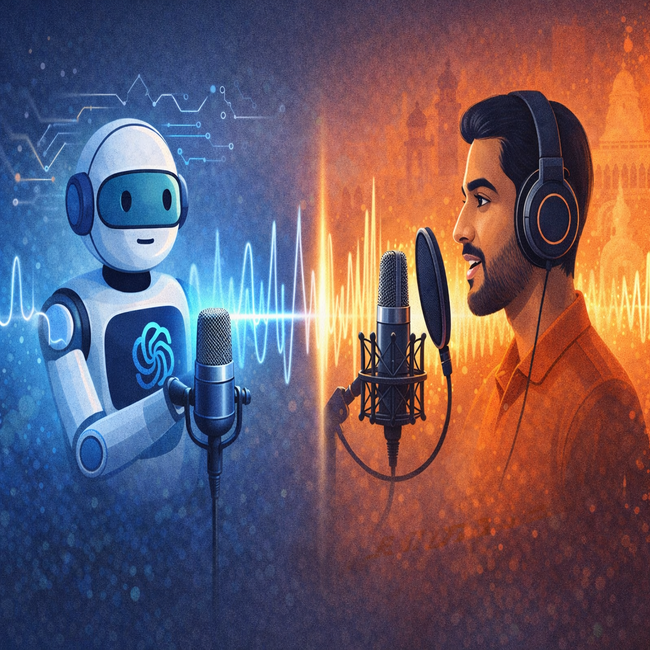

Artificial intelligence is beginning to reshape the sound of advertising. AI-generated voiceovers, once a novelty, are now being used in campaigns across India and globally. What started as simple synthetic narration has evolved into natural-sounding voices that mimic emotion, tone and even celebrity personalities. This shift has created both excitement and anxiety across marketing, production and the voiceover industry.
AI narration allows brands to produce voiceovers at speed, localize content across regions and test multiple versions of the same ad at low cost. Global brands have experimented early. For instance, Mondelez recreated actor Farhan Akhtar’s voice for personalized digital messages in a previous Oreo campaign. The same brand used an AI recreation of Shah Rukh Khan’s voice in an earlier Diwali ad to promote local stores. These examples showed that AI could deliver personalization at scale, while also revealing how sensitive audiences are to human likeness.
Consumer trust reflects this tension. Independent surveys show that a majority of people trust real voices significantly more than synthetic ones. In a widely referenced audio trust study, 55 percent of people expressed trust in human voices, while only 23 percent said they trusted AI-generated ones. While synthetic voices are improving, the emotional gap remains a concern for many creatives.
Despite this, brands are adopting AI narration at remarkable speed. India has become a fertile ground for experimentation because of its linguistic diversity and the growing demand for hyper-personalisation. In 2024, redBus created its first Primo ad series using localized videos in eight Indian languages. The videos featured not only tailored messaging but also AI-generated voiceovers customised for more than 300 bus operators. Each version highlighted local business names and voice lines specific to regional audiences.
Travel platform Agoda followed with one of the largest AI-led video personalisation campaigns in India. A single filmed video featuring Ayushmann Khurrana was converted into more than 250 regional versions using generative AI tools. The campaign included localized dubbing and AI-modified lip-sync for city-specific promotions. Krishna Rathi, Country Director India at Agoda, said the intention was to create more meaningful engagement. He explained that their generative AI campaign helped them reach individuals “in a very personal way” tailored to the destination each traveller was most likely to explore.
The momentum is reflected in market data. An Adobe study from 2024 shows that 23 percent of Indian businesses now report measurable gains from using generative AI. Another industry report notes that 41 percent of brands use AI to create video content, more than double the number from the previous year. India’s conversational AI market, which includes voice technology, is expected to grow from about 455 million dollars in 2024 to more than 1.8 billion dollars by 2030. Globally, the AI voice generator market was about 6.4 billion dollars in 2025 and is forecast to reach more than 54 billion dollars by 2033.
Technology leaders believe this pace will accelerate. Varun Mohan, Chief Commercial Officer at MiQ, notes that AI tools act as a force multiplier. He says that brands that invest early and upskill teams for AI adoption will stay ahead of the curve. Blink Digital’s co-founder Rikki Agarwal, whose team co-created Agoda’s personalisation campaign, believes AI voice tools allow creative ideas to scale. He says that blending creativity with advanced technology represents the next phase of advertising innovation.
Even platform companies emphasize inclusivity as a driver. OpenAI’s India marketing lead Sheeladitya Mohanty recently commented that audiences should not have to switch to English to use AI tools. He noted that their Indian advertisements were based on real user scenarios where people relied on AI in the language they were most comfortable with, including Hindi, Tamil, and Bengali.
However, not everyone is optimistic. Traditional voice actors and dubbing studios are facing pressure as routine narration work begins to shift to AI. The Association of Voice Artists of India has begun advising members on protecting their voice rights. General Secretary Amarinder Singh Sodhi has publicly stated that work volumes have declined for many artists. He said that if earlier a voice actor could do fifteen to twenty projects a month, that number has dropped to six or seven for many because of increased use of synthetic voices.
Voice artists are also concerned about consent and misuse. Dubbing professional Rakhee Sharma has expressed that her voice is part of her identity and that the idea of someone sending her a clip of hate speech with her cloned voice would be horrifying. Veteran voice actor Aditya Mathur has warned that if his voice is cloned into multiple languages without approval, he loses rightful compensation. The community argues that voice likeness should be treated with the same seriousness as image rights.
AI voice startups in India say they are aware of these concerns. Companies working on Indian-language voice models argue that AI should be positioned as a tool, not a replacement. Technology experts note that synthetic voices still struggle to deliver the emotional nuance required for dramatic storytelling or character-heavy scripts. For now, most AI voiceovers are used for informational videos, explainers, corporate films and quick digital ads rather than high-budget television spots.
Several Indian audio tech firms are building solutions to support brands. Bengaluru’s Sarvam AI and Pune-based Bolna are developing multilingual voice models tailored for Indian accents. Conversational AI firms like Gnani are experimenting with real-time synthetic voice agents. Global companies such as ElevenLabs, which has seen rapid adoption of its text-to-speech tools, say the future will rely on creative collaboration between humans and AI. Their India team has repeatedly said that AI voices expand creative possibilities but are most effective when combined with human emotion and direction.
The voiceover landscape now sits at a crossroads. On one hand, AI narration brings speed, scale and affordability. Brands can create localized voiceovers for dozens of markets within hours. On the other, audiences still recognise and value the warmth of a real voice. Creative leaders believe that the best advertising strikes a balance. AI will likely handle fast-turnaround and functional narration, while human artists continue to shape the emotional core of brand storytelling.
The heart of the debate is not technology but trust. For AI-narrated ads to succeed, brands must ensure consent, transparency, quality control and respect for voice rights. As one strategist observed, AI can help maintain tone and language consistency across markets, but cultural nuance still requires human oversight.
For now, the voiceover wars are far from over. India’s advertising ecosystem is experimenting openly, with AI and human voices working side by side. The sound of advertising is changing, but the final mix will depend on how brands balance innovation with authenticity in the years ahead.
Disclaimer: All data points and statistics are attributed to published research studies and verified market research. All quotes are either sourced directly or attributed to public statements.
Related Articles


