
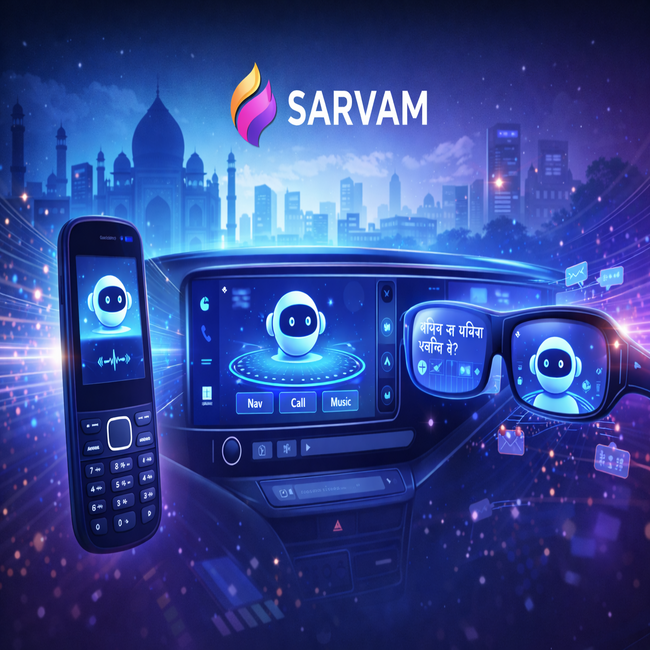

Indian artificial intelligence startup Sarvam is working to extend its AI models beyond smartphones and cloud platforms, targeting deployment across feature phones, cars and smart glasses. The initiative reflects the company’s ambition to broaden access to AI capabilities by embedding intelligence directly into devices used by millions of people in everyday settings.
Sarvam’s focus on non traditional form factors highlights a strategic shift toward on device and edge based AI. Rather than relying solely on internet connected smartphones or servers, the company is exploring how lightweight AI models can operate efficiently on constrained hardware. This approach aligns with India’s diverse device ecosystem, where feature phones and embedded systems continue to play a significant role.
Feature phones remain widely used across India, particularly in rural and semi urban regions. While smartphone adoption has grown rapidly, a substantial portion of the population still relies on basic devices with limited computing power. Sarvam’s effort to bring AI to feature phones aims to address this gap by enabling voice based assistance, local language support and basic automation without requiring high end hardware.
The company’s plans also extend to automotive environments. Integrating AI into vehicles could enable voice driven navigation, contextual assistance and driver support features. As connected cars gain traction globally, AI powered interfaces are becoming an important component of user experience. Sarvam sees an opportunity to localise these capabilities for Indian use cases.
Smart glasses represent another area of exploration. While still an emerging category, wearable devices are increasingly viewed as potential interfaces for contextual and hands free computing. AI models embedded in smart glasses could assist with translation, navigation and real time information overlays.
Sarvam’s strategy reflects a broader push to make AI more inclusive. Many generative AI systems today assume consistent connectivity and powerful hardware. By contrast, Sarvam is prioritising deployment scenarios that account for bandwidth limitations, power constraints and affordability.
To support this vision, the company is focusing on developing compact models optimised for efficiency. Running AI on device requires balancing performance with resource usage. Models must deliver useful outputs while operating within tight memory and processing limits.
Local language support is central to Sarvam’s roadmap. India’s linguistic diversity presents both challenges and opportunities for AI adoption. Voice interfaces in regional languages could significantly improve accessibility for users who are not comfortable with English or text based input.
Industry observers note that deploying AI on feature phones and embedded systems requires close collaboration with hardware manufacturers and platform providers. Integration at the device level involves optimising software stacks and ensuring compatibility with existing ecosystems.
Sarvam’s approach also aligns with growing interest in edge AI. Processing data locally can reduce latency and improve privacy by limiting the need to transmit sensitive information to remote servers. For applications such as in car assistance, low latency responses are critical.
The company has indicated that it is exploring partnerships to enable deployment across different device categories. Collaborations with telecom operators, automotive suppliers and device makers could play a role in scaling adoption.
Sarvam’s ambition comes at a time when India is seeking to strengthen its domestic AI capabilities. Policymakers and industry leaders have emphasised the importance of building local models that reflect Indian contexts and languages. Expanding deployment beyond smartphones could help realise these goals.
Analysts suggest that feature phone based AI could unlock new use cases in agriculture, healthcare and public services. Voice driven information systems may help users access advice, schedules and alerts without navigating complex interfaces.
In the automotive sector, AI powered assistants could support drivers with navigation, safety prompts and contextual information. Localised models tailored for Indian roads and driving conditions may offer advantages over generic systems.
Smart glasses, while still niche, could find applications in logistics, field services and training. AI assisted overlays may help workers perform tasks more efficiently. However, adoption will depend on cost, usability and ecosystem maturity.
Sarvam’s focus on multiple device categories underscores a belief that AI’s future lies beyond a single dominant interface. As computing becomes more distributed, intelligence embedded across devices may become more common.
Challenges remain in achieving reliable performance on constrained hardware. Model optimisation, energy efficiency and update mechanisms are complex problems. Ensuring consistent quality across devices will require ongoing iteration.
The business model for such deployments is also evolving. Monetisation strategies for feature phone AI differ from app based subscriptions. Partnerships and enterprise use cases may play a larger role.
Despite these challenges, Sarvam’s initiative highlights a distinct approach within India’s AI startup ecosystem. Rather than competing solely in cloud based generative AI, the company is focusing on practical deployment across widely used devices.
The strategy may help Sarvam differentiate itself in a crowded market. By addressing underserved segments, the company could build relevance beyond urban smartphone users.
As AI continues to mature, questions around accessibility and inclusivity are gaining prominence. Ensuring that benefits reach diverse populations requires adapting technology to local realities.
Sarvam’s plans reflect this perspective. By targeting feature phones, cars and smart glasses, the startup is positioning AI as a utility that fits into everyday environments rather than a specialised tool.
The timeline for large scale deployment remains unclear, and success will depend on execution and partnerships. However, the direction signals confidence that AI can operate effectively beyond traditional platforms.
As India’s digital landscape continues to evolve, efforts to embed AI into a broader range of devices may shape how technology is experienced by users. Sarvam’s initiative offers a glimpse into how AI could become more pervasive and accessible across the country.
If realised, the strategy could contribute to expanding AI adoption in contexts where smartphones and high speed connectivity are not guaranteed. This focus on inclusivity may influence how future AI products are designed for emerging markets.
Sarvam’s vision underscores a key idea shaping the next phase of AI development. Intelligence does not need to be confined to powerful devices. By adapting models for diverse hardware, AI can reach users wherever they are.